Aquarium planner › Guides › Gravel and sand per tank
How much gravel or sand do I need? Pounds for every standard tank
Short answer
For a 2 inch bed of dry sand you need about:
- 5.5 gallon: 15 lb of sand (16 lb gravel)
- 10 gallon: 24 lb of sand (26 lb gravel)
- 20 gallon long or 29 gallon: 42 lb (46 lb gravel). Same floor, same amount.
- 20 gallon high: 34 lb (37 lb gravel)
- 40 gallon breeder: 74 lb · 55 gallon: 69 lb · 75 gallon: 101 lb
Substrate covers the floor, so it scales with length × width, not with gallons. Halve these for 1 inch, add half again for 3 inches.
Ask how much gravel a tank needs and you will usually get an answer in pounds per gallon. That shortcut assumes every tank has the same proportions, and the standard US sizes do not: the floor area per gallon varies more than threefold between them. Below is the calculation from each tank's actual floor, for sand and gravel, at the depths people actually use.
How the numbers are worked out
Pounds = floor length × floor width × bed depth (in³) × 0.016387 L/in³ × bulk density (kg/L) × 2.2046
Dry sand is taken as 1,555 kg/m³ (97 lb/ft³) and dry gravel as 1,680 kg/m³ (105 lb/ft³), from the Engineering ToolBox density table (read 28 October 2026). Real products vary with grain size and shape. The floor is the published outside footprint from the Aqueon catalog; the inside floor is slightly smaller, so these figures lean towards buying a little too much, which is the right side to err on.
Sand and gravel for every standard tank
| Tank | Outside floor | Sand, 1 in | Sand, 2 in | Gravel, 2 in | Sand, 3 in | 20 lb bags (2 in gravel) |
|---|---|---|---|---|---|---|
| 2.5 gallon | 12 3⁄16 × 6⅛ in | 4 lb | 8 lb | 9 lb | 13 lb | 1 |
| 5.5 gallon | 16 3⁄16 × 8⅜ in | 8 lb | 15 lb | 16 lb | 23 lb | 1 |
| 10 gallon | 20¼ × 10½ in | 12 lb | 24 lb | 26 lb | 36 lb | 2 |
| 15 gallon | 24¼ × 12½ in | 17 lb | 34 lb | 37 lb | 51 lb | 2 |
| 20 gallon high | 24¼ × 12½ in | 17 lb | 34 lb | 37 lb | 51 lb | 2 |
| 20 gallon long | 30¼ × 12½ in | 21 lb | 42 lb | 46 lb | 64 lb | 3 |
| 29 gallon | 30¼ × 12½ in | 21 lb | 42 lb | 46 lb | 64 lb | 3 |
| 30 gallon | 36¼ × 12⅝ in | 26 lb | 51 lb | 56 lb | 77 lb | 3 |
| 33 gallon long | 48¼ × 12¾ in | 35 lb | 69 lb | 75 lb | 104 lb | 4 |
| 38 gallon | 36¼ × 12⅝ in | 26 lb | 51 lb | 56 lb | 77 lb | 3 |
| 40 gallon breeder | 36 3⁄16 × 18¼ in | 37 lb | 74 lb | 80 lb | 111 lb | 5 |
| 45 gallon | 36¼ × 12⅝ in | 26 lb | 51 lb | 56 lb | 77 lb | 3 |
| 55 gallon | 48¼ × 12¾ in | 35 lb | 69 lb | 75 lb | 104 lb | 4 |
| 60 gallon breeder | 48½ × 18½ in | 50 lb | 101 lb | 109 lb | 151 lb | 6 |
| 65 gallon | 36⅜ × 18⅜ in | 38 lb | 75 lb | 81 lb | 113 lb | 5 |
| 75 gallon | 48½ × 18½ in | 50 lb | 101 lb | 109 lb | 151 lb | 6 |
| 90 gallon | 48½ × 18½ in | 50 lb | 101 lb | 109 lb | 151 lb | 6 |
| 125 gallon | 72½ × 18½ in | 75 lb | 151 lb | 163 lb | 226 lb | 9 |
| 150 gallon | 72½ × 18½ in | 75 lb | 151 lb | 163 lb | 226 lb | 9 |
| 210 gallon | 72½ × 24½ in | 100 lb | 200 lb | 216 lb | 299 lb | 11 |
Floor: outside length × width from the Aqueon catalog, p. 66. Weights rounded to the nearest pound; bags rounded up. Each tank name links to its dimensions on the size chart.
Why pounds per gallon goes wrong
For a 2 inch sand bed, the pounds needed per label gallon run from 3.4 lb on the smallest tank down to 1.0 lb on the largest. In the middle of the range:
- A 20 gallon long needs 2.1 lb per gallon; a 20 gallon high, 1.7 lb. Same gallons, but the long tank's floor is a quarter bigger.
- A 29 gallon needs 1.5 lb per gallon. It is a 20 long with taller glass: identical floor, so identical substrate, spread over 9 more gallons.
- A 55 gallon needs 1.3 lb per gallon and a 40 gallon breeder 1.9. The breeder's floor is bigger than the 55's, so it takes more sand despite holding 15 gallons less.
Any per-gallon rule is tuned to one shape. Short, wide tanks need more than it says; tall tanks need less. Work from the floor and the shape stops mattering. how standard tank footprints compare lists which sizes share a floor.
Sloped beds
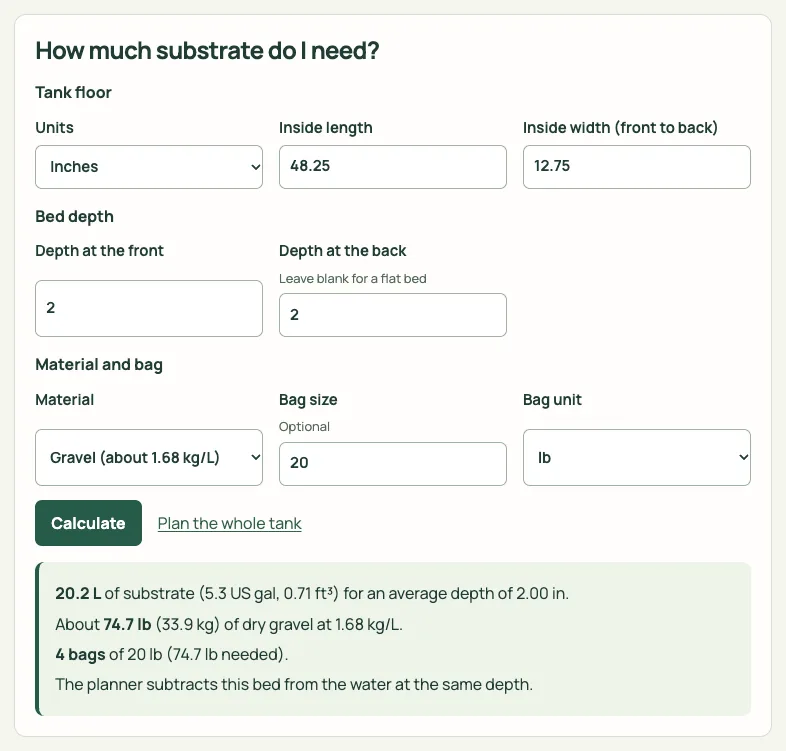
A bed that rises towards the back is a wedge, so its volume uses the average of the front and back depths. A 75 gallon sloped from 2 in at the front to 4 in at the back averages 3 in: about 151 lb of sand (44.1 L), the same as a flat 3 inch bed. A deeper back leaves more room where tall plants usually go.
Aquasoil: buy by volume
Planted-tank soils are light and porous, and their bags are sold in litres, so skip the pounds. A 2 inch layer is 12.4 L on a 20 long, 21.6 L on a 40 breeder and 29.4 L on a 75. With 9 L bags that is 2, 3 and 4 bags. Check the bag size on the product you buy and enter it in the substrate calculator under “by volume”.
Substrate and your water volume
Two inches of sand on a 55 gallon floor takes 20.2 L of space that would otherwise be water, which is why the real water in a set-up tank is well below the label (how many gallons your tank really holds). It is also heavy: those 69 lb sit on the stand on top of the water (fish tank weight by size). In the planner, enter the average depth under “Fine-tune usable water” and the net water, water changes and water weight all use the reduced figure.
Sources and method
- Bulk densities: Engineering ToolBox, Dirt, Mud and Sand – Densities: sand, dry 97 lb/ft³ (1,555 kg/m³); gravel, dry 105 lb/ft³ (1,680 kg/m³). Read 28 October 2026.
- Tank floors: Aqueon aquarium catalog, p. 66, read 28 October 2026.
- All weights, litres and bag counts are calculated with the same code as the substrate calculator.