Aquarium planner › Guides › Fish tank weight
How much does a fish tank weigh? 20, 55, 75 gallon and every standard size
Short answer
A filled 20 gallon tank weighs about 225 lb (long or high), a 10 gallon 111 lb, a 55 gallon about 625 lb (283 kg), a 75 gallon about 785 lb and a 125 gallon about 1,400 lb, according to the Aqueon catalog. Across the 20 standard sizes the filled weight works out at 9.1–12.0 lb per label gallon, so “about 11 lb per gallon” is a fair first estimate. The water alone is 8.3 lb per US gallon.
- Stands care about the load per square foot too: a filled 55 gallon puts 146 lb on each square foot of its footprint, 16% more than a 75 gallon (126 lb/ft²).
- The catalog notes that filled weights vary with substrate and decor. Sand, rock and the stand come on top.
Most weight charts multiply the gallons on the label by 8.34 lb and stop there. That gives you the water in a tank that is filled to the brim with nothing in it, which is not the tank you will own. Below are the manufacturer's own empty and filled weights for every standard size, what the water alone weighs, and the figure that matters most for where the tank goes: how much of that weight sits on each square foot.
Fish tank weight by size
Empty and filled weights are copied from the Aqueon catalog, page 66 (Critical dimensions for all aquariums), which measures tanks outside the frame. Everything else is calculated and labelled as such.
| Tank | Empty | Filled | Water alone* | Filled per gallon* | Footprint* | Load on footprint* |
|---|---|---|---|---|---|---|
| 2.5 gallon | 2.6 lb | 27 lb12 kg | 21 lb | 10.8 lb | 0.5 ft² | 52 lb/ft² |
| 5.5 gallon | 7 lb | 62 lb28 kg | 46 lb | 11.3 lb | 0.9 ft² | 66 lb/ft² |
| 10 gallon | 11 lb | 111 lb50 kg | 83 lb | 11.1 lb | 1.5 ft² | 75 lb/ft² |
| 15 gallon | 21 lb | 170 lb77 kg | 125 lb | 11.3 lb | 2.1 ft² | 81 lb/ft² |
| 20 gallon high | 25 lb | 225 lb102 kg | 166 lb | 11.3 lb | 2.1 ft² | 107 lb/ft² |
| 20 gallon long | 25 lb | 225 lb102 kg | 166 lb | 11.3 lb | 2.6 ft² | 86 lb/ft² |
| 29 gallon | 40 lb | 330 lb150 kg | 241 lb | 11.4 lb | 2.6 ft² | 126 lb/ft² |
| 30 gallon | 43 lb | 343 lb156 kg | 250 lb | 11.4 lb | 3.2 ft² | 108 lb/ft² |
| 33 gallon long | 46 lb | 382 lb173 kg | 275 lb | 11.6 lb | 4.3 ft² | 89 lb/ft² |
| 38 gallon | 47 lb | 427 lb194 kg | 316 lb | 11.2 lb | 3.2 ft² | 134 lb/ft² |
| 40 gallon breeder | 58 lb | 458 lb208 kg | 333 lb | 11.5 lb | 4.6 ft² | 100 lb/ft² |
| 45 gallon | 69 lb | 515 lb234 kg | 374 lb | 11.4 lb | 3.2 ft² | 162 lb/ft² |
| 55 gallon | 78 lb | 625 lb283 kg | 458 lb | 11.4 lb | 4.3 ft² | 146 lb/ft² |
| 60 gallon breeder | 43 lbsee note | 543 lb246 kg | 499 lb | 9.1 lb | 6.2 ft² | 87 lb/ft² |
| 65 gallon | 90 lb | 775 lb352 kg | 541 lb | 11.9 lb | 4.6 ft² | 167 lb/ft² |
| 75 gallon | 98 lb | 785 lb356 kg | 624 lb | 10.5 lb | 6.2 ft² | 126 lb/ft² |
| 90 gallon | 135 lb | 1,050 lb476 kg | 749 lb | 11.7 lb | 6.2 ft² | 169 lb/ft² |
| 125 gallon | 177 lb | 1,400 lb635 kg | 1,040 lb | 11.2 lb | 9.3 ft² | 150 lb/ft² |
| 150 gallon | 281 lb | 1,800 lb816 kg | 1,248 lb | 12.0 lb | 9.3 ft² | 193 lb/ft² |
| 210 gallon | 343 lb | 2,450 lb1,111 kg | 1,747 lb | 11.7 lb | 12.3 ft² | 199 lb/ft² |
Empty and filled: catalog. * Calculated. Water alone = label gallons × 3.785 L × 0.997 kg/L (fresh water at 26.7 °C, USGS water density table) = 8.32 lb per gallon. Filled per gallon = filled ÷ label gallons. Footprint = outside length × width ÷ 144. Load on footprint = filled weight ÷ footprint. The 60 gallon breeder's empty weight is printed as 43 lb, lower than the smaller 55 gallon's 78 lb; it is shown as printed. Each tank name links to its row on the aquarium size chart.
Why the filled weight is more than gallons × 8.3
A filled 55 gallon at 625 lb is 11.4 lb per label gallon, not 8.3. The difference is the glass, the trim and whatever the catalog assumes about the contents. The catalog does not say what its filled weight includes beyond its note that substrate and decor change it, so treat it as a planning figure and add your own extras:
- Substrate: a 2 inch sand bed in a 55 gallon is about 69 lb more (worked out in how much gravel or sand each tank needs).
- Rock and wood: weigh them on a bathroom scale before they go in. They replace some water, so they add less than their own weight, but dense rock still adds a lot.
- The stand and the equipment: canister filters, lids and lights are not in any tank figure.
The water you actually have is also less than the label, because nobody fills to the brim and the glass takes up space. A 55 gallon filled an inch below the rim over 2 inches of sand holds about 44.9–47.9 gallons (the range is explained in how many gallons your tank really holds). That lowers the water weight, but the substrate you added weighs more per gallon than the water it displaced, so the catalog figure stays a sensible total.
Per square foot, narrow and tall tanks press hardest
Total weight decides how strong the stand must be. How that weight is spread decides how much it loads the floor under the stand. Dividing the catalog's filled weight by the outside footprint gives the load per square foot of each tank's base. The five highest:
- 210 gallon: 199 lb/ft² (2,450 lb on 72½ × 24½ in)
- 150 gallon: 193 lb/ft² (1,800 lb on 72½ × 18½ in)
- 90 gallon: 169 lb/ft² (1,050 lb on 48½ × 18½ in)
- 65 gallon: 167 lb/ft² (775 lb on 36⅜ × 18⅜ in)
- 45 gallon: 162 lb/ft² (515 lb on 36¼ × 12⅝ in)
The 210 gallon tops the list at 199 lb/ft², while the 2.5 gallon is only 52 lb/ft². Tall tanks on a narrow base stack more water over each square foot. That is why a 55 gallon (146 lb/ft² on 4.3 ft²) loads its footprint harder than a 75 gallon (126 lb/ft² on 6.2 ft²), even though the 75 is heavier in total. The 20 gallon high and 20 gallon long weigh the same filled (225 lb), but the high one puts 107 lb/ft² on the floor against 86 for the long.
For scale: the International Residential Code sets a minimum uniformly distributed live load of 40 lb/ft² for rooms other than sleeping areas and 30 lb/ft² for sleeping areas (IRC 2021, Table R301.5, read 28 October 2026). A filled 55 gallon concentrates 3.7 times that figure on its own footprint. The code figure is a minimum design load averaged over a room, not a limit for one spot, so this is not a verdict on any particular floor. It does explain the usual advice: put large tanks across the joists, close to a load-bearing wall, and ask a structural engineer before putting a big tank on an upper floor or an old one.
Small tanks: 2.5 to 20 gallons
The small sizes are easy to underestimate because you can lift them empty: a 10 gallon is 11 lb empty and 111 lb filled. Check the rated load of whatever it stands on before you fill it, and prefer a stand made for the tank, which the catalog also asks for.
Weigh your own tank
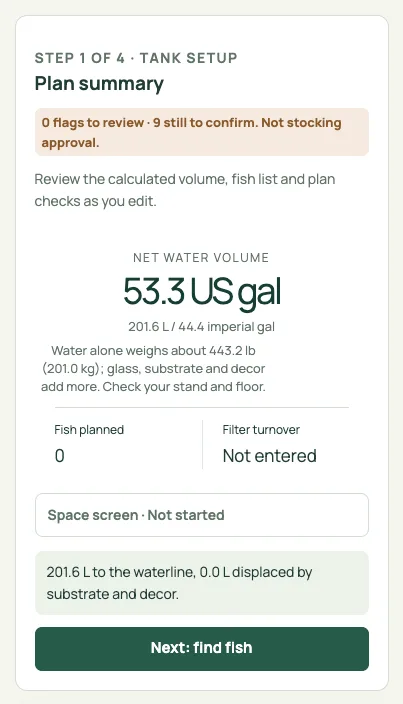
For a tank that is not a standard size, or to include your substrate and decor, enter the inside measurements in the Finpado planner. It reports the net water in litres and gallons and the weight of that water at 0.997 kg per litre. Add the empty tank weight from the maker's label and the substrate from the substrate calculator to get a total you can compare with the stand's rating.
Sources and method
- Tank dimensions and empty and filled weights: Aqueon aquarium catalog, p. 66, read 28 October 2026. Other brands differ by a fraction of an inch and a few pounds.
- Water density 0.997 kg/L at 26.7 °C: USGS Water Science School, read 28 October 2026. 1 US gallon = 3.785 412 L (NIST SP 811, B.9).
- Floor live loads: 2021 International Residential Code, Table R301.5, read 28 October 2026.
- All other figures are arithmetic on those numbers, shown beside each table. Finpado's full method and corrections log: sources and methods.