Aquarium planner › Guides › How many gallons is my tank
How to calculate the gallons in a fish tank, and why the label is wrong
Short answer
Measure inside the glass in inches: length × width × water height ÷ 231 = US gallons. In centimetres, length × width × water height ÷ 1,000 = litres. Then subtract the substrate layer.
- The gallon number on the label is a size class. A standard 55 gallon measures 48¼ × 12¾ × 21 in outside, a box of 55.9 gallons.
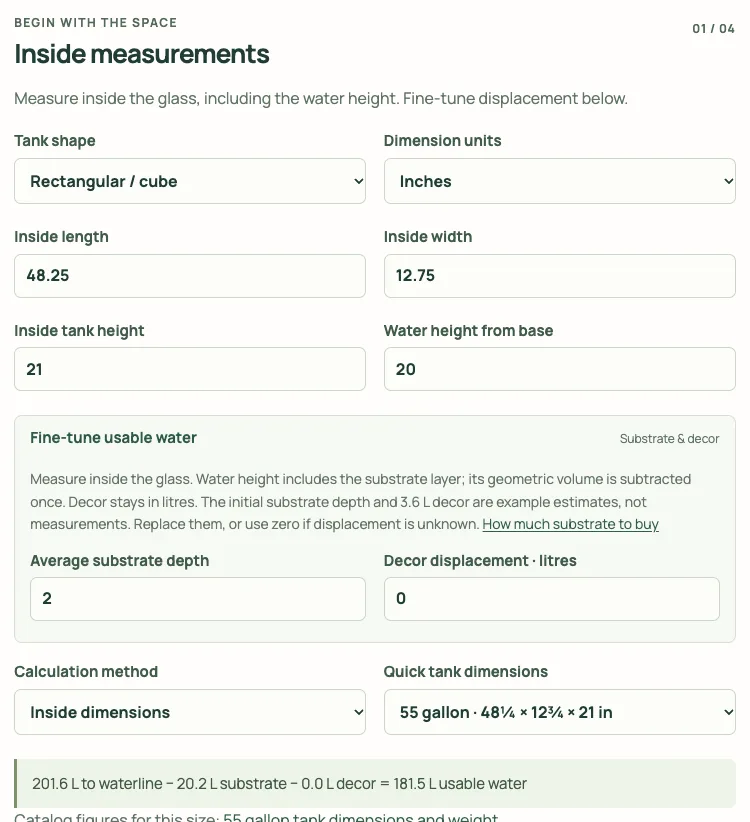
- Filled 1 inch below the rim over 2 inches of substrate, that box holds at most 47.9 gallons of water, and about 44.9 gallons if the glass is ¼ in thick: 82% of the label.
- Across 20 standard sizes the same assumptions give 55–98% of the label. Use the real figure for medication doses and water changes.
The question sounds like it has a one-line answer, and the formula does. The catch is which measurements go into it. Retail sizes are measured outside the frame, tanks are not filled to the brim, and the gravel takes a slice off the bottom. Each of those is small on its own. Together, on the standard 10 to 75 gallon sizes, they take about 6–27% off the label, and more off the nano tanks.
The formula, and what to measure
US gallons = inside length × inside width × water height (inches) ÷ 231
Litres = inside length × inside width × water height (cm) ÷ 1,000
231 is the number of cubic inches in a US gallon (NIST SP 811, B.9). For imperial gallons divide by 277.42 instead; an imperial gallon holds about a fifth more (more in how much water weighs by the gallon).
- Inside length and width: measure glass to glass, not across the plastic trim.
- Water height: from the bottom glass to the water line, not to the top of the tank. Most tanks run an inch or more below the rim.
- Substrate: its average depth comes off the water height, once. Rock and wood come off as their own volume.
Bow-front, corner, cylinder and hexagon tanks use a different footprint in place of length × width; the aquarium volume formulas page has each one with a worked example.
Worked example: a standard 55 gallon
The Aqueon catalog gives the 55 gallon as 48¼ × 12¾ × 21 in, measured outside the frame. Step by step:
- Outside box: 12,919 in³ ÷ 231 = 55.9 gallons. This already includes the glass and frame.
- Water 1 in below the rim: each inch of height on this footprint is 2.7 gallons, so that inch is gone.
- 2 in of sand: another 5.3 gallons of space, now filled with sand instead of water.
- That leaves 47.9 gallons, still measured to the outside of the glass. If the walls and base were ¼ in thick (an illustration; the catalog does not publish glass thickness or inside sizes), the inside loses half an inch of length and width and a quarter inch of height: 44.9 gallons.
So a medication dosed for “55 gallons” in this tank would be about 22% stronger than the label suggests. The real figure matters most for medication, fertiliser and conditioner, and for the size of each water change.
Label against real water, 20 standard tanks
Same assumptions for every size: published outside dimensions, water 1 in below the rim, a flat 2 in substrate bed. The last two columns repeat that with ¼ in walls and base as an illustration of what the glass takes.
| Tank | Label | Outside box | Filled 1 in below rim, 2 in substrate | Same, if glass were ¼ in | Share of label |
|---|---|---|---|---|---|
| 2.5 gallon | 2.5 gal | 2.6 gal | 1.7 gal | 1.4 gal | 55% |
| 5.5 gallon | 5.5 gal | 6.2 gal | 4.4 gal | 3.9 gal | 70% |
| 10 gallon | 10 gal | 11.6 gal | 8.8 gal | 8.0 gal | 80% |
| 15 gallon | 15 gal | 16.7 gal | 12.8 gal | 11.7 gal | 78% |
| 20 gallon high | 20 gal | 22.0 gal | 18.0 gal | 16.7 gal | 83% |
| 20 gallon long | 20 gal | 20.9 gal | 16.0 gal | 14.7 gal | 73% |
| 29 gallon | 29 gal | 30.7 gal | 25.8 gal | 24.0 gal | 83% |
| 30 gallon | 30 gal | 33.2 gal | 27.2 gal | 25.3 gal | 84% |
| 33 gallon long | 33 gal | 35.6 gal | 27.6 gal | 25.6 gal | 78% |
| 38 gallon | 38 gal | 39.1 gal | 33.2 gal | 31.0 gal | 81% |
| 40 gallon breeder | 40 gal | 48.4 gal | 39.8 gal | 37.5 gal | 94% |
| 45 gallon | 45 gal | 47.1 gal | 41.1 gal | 38.5 gal | 85% |
| 55 gallon | 55 gal | 55.9 gal | 47.9 gal | 44.9 gal | 82% |
| 60 gallon breeder | 60 gal | 62.1 gal | 50.5 gal | 47.7 gal | 79% |
| 65 gallon | 65 gal | 72.3 gal | 63.7 gal | 60.4 gal | 93% |
| 75 gallon | 75 gal | 82.1 gal | 70.4 gal | 66.9 gal | 89% |
| 90 gallon | 90 gal | 97.6 gal | 85.9 gal | 81.8 gal | 91% |
| 125 gallon | 125 gal | 134.3 gal | 116.9 gal | 111.5 gal | 89% |
| 150 gallon | 150 gal | 171.3 gal | 153.9 gal | 147.3 gal | 98% |
| 210 gallon | 210 gal | 227.8 gal | 204.7 gal | 197.3 gal | 94% |
Outside box = L × W × H ÷ 231. Filled = L × W × (H − 1 − 2) ÷ 231. With glass = (L − ½) × (W − ½) × (H − ¼ − 1 − 2) ÷ 231. Dimensions: Aqueon catalog, p. 66, read 28 October 2026. Real glass thickness varies by size and brand; the illustrative column is not a measurement.
The pattern: the smaller and shallower the tank, the bigger the gap. One inch of rim and two inches of sand are a larger share of a 12 in tall 10 gallon than of a 21 in tall 75 gallon. A 10 gallon ends up near 80% of its label and a 75 gallon near 89%.
The surest method: count it
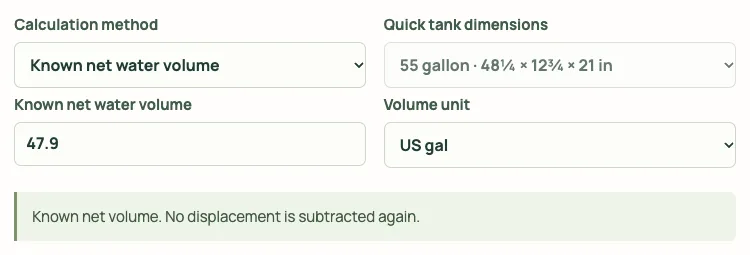
If the tank is already set up, the most accurate figure is the water you put in. Count buckets of a known size while filling, or after a water change note how many buckets brought it back to the line. In the planner, switch the calculation method to Known net water volume and enter that figure; it is then used as it is, without subtracting substrate again.
What to do with the number
- Plan water changes from the real figure: what each water change percentage does.
- Check what the full tank weighs on its stand: fish tank weight by size.
- Look up any standard size on the aquarium size chart.
Sources and method
- Outside dimensions: Aqueon aquarium catalog, p. 66, read 28 October 2026.
- 231 in³ per US gallon, 277.42 in³ per imperial gallon: NIST SP 811, Appendix B.9, read 28 October 2026.
- The rim, substrate and glass allowances are stated assumptions, not measurements; every result above is arithmetic on the published size. Method: sources and methods.