Aquarium planner › Guides › Water change percentage
How often should you change fish tank water, and how much? What 10%, 25% and 50% do
Short answer
A water change of p% removes p% of the nitrate (and everything else dissolved) in one go. On a fixed weekly routine, nitrate settles where each change removes what one week added:
Level before each change ≈ weekly rise ÷ change fraction + nitrate in your new water
- How often and how much trade off against each other: what sets the level is the share of water replaced per week compared with how fast nitrate rises.
- 25% a week settles at 4 × the weekly rise; 50% a week at 2 ×; 10% a week at 10 ×.
- With nitrate rising 10 mg/L a week: about 100 mg/L at 10%, 40 mg/L at 25% and 20 mg/L at 50%.
- So the right percentage depends on your own weekly rise. Two nitrate tests, just after one change and just before the next, give you that number.
Advice on water changes usually comes as a percentage and a schedule, with no reasoning attached. The reasoning is short arithmetic, and once you have it you can pick a routine for your own tank instead of borrowing someone else's. Everything below is mixing maths; it applies to nitrate and to anything else that builds up between changes.
What one change does
Take out p% of the water and you take out p% of the nitrate. Replace it with new water, and the new water brings its own nitrate back in:
Nitrate after = nitrate before × (1 − p) + nitrate in the new water × p
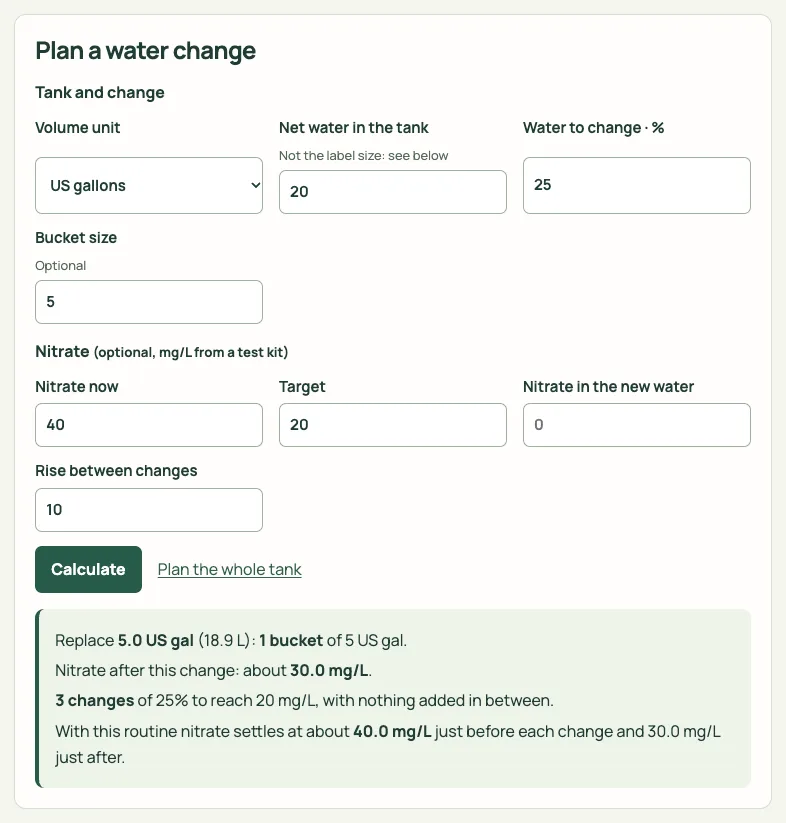
A 25% change with nitrate-free water takes 40 mg/L to 30 mg/L. It cannot take the tank below the level in the new water, so test your tap or source water once: that is your floor.
10% to 50%: the numbers side by side
| Weekly change | Old water left after 1 change | After 4 weeks | Changes to halve nitrate | Steady level before each change | With 10 mg/L added a week |
|---|---|---|---|---|---|
| 10% | 90% | 66% | 7 | 10.0 × weekly rise | 100 mg/L |
| 15% | 85% | 52% | 5 | 6.7 × weekly rise | 67 mg/L |
| 20% | 80% | 41% | 4 | 5.0 × weekly rise | 50 mg/L |
| 25% | 75% | 32% | 3 | 4.0 × weekly rise | 40 mg/L |
| 30% | 70% | 24% | 2 | 3.3 × weekly rise | 33 mg/L |
| 40% | 60% | 13% | 2 | 2.5 × weekly rise | 25 mg/L |
| 50% | 50% | 6% | 1 | 2.0 × weekly rise | 20 mg/L |
Old water left = (1 − p)n. Changes to halve = the smallest n with (1 − p)n ≤ ½. Steady level = rise ÷ p before each change, with nitrate-free new water; add your tap level if it has some. The last column uses an example rise of 10 mg/L a week.
Two small changes are not one big one
The second change removes a share of what is left, so the effect shrinks each time. Two 25% changes replace 43.8% of the old water, not 50%; four 10% changes replace 34.4%. Bringing a high reading down takes more small changes than the percentages add up to: from 40 mg/L to 20 mg/L takes 3 changes of 25%, one change of 50%.
What small changes buy is a gentler shift: temperature and water chemistry move less at once. If a tank has gone a long time without a change, several smaller changes spread that shift out.
Where a routine settles
Fish and food keep adding waste, so nitrate climbs between changes. If you change the same share at the same interval, the level stops climbing at the point where each change removes exactly what one interval added: rise = level × p, so level = rise ÷ p. That is the steady level in the table.
The same water can be split differently. Compare two routines that both replace half the tank's water each week, with nitrate rising 10 mg/L a week:
- 50% once a week: peaks at 10 ÷ 0.5 = 20 mg/L before each change and falls to 10 mg/L after it.
- 25% twice a week: the rise per interval halves to 5 mg/L, so it peaks at 5 ÷ 0.25 = 20 mg/L and falls to 15 mg/L after each change.
Same peak, same water used. The weekly 50% reaches a lower low; the twice-weekly 25% moves the tank less each time. Which is better depends on your fish and your time, but neither is the “stronger” routine.
When your tap water has nitrate
New water with nitrate in it lifts the whole routine by that amount. With 10 mg/L in the tap, a 25% weekly change and a 10 mg/L weekly rise, the tank settles at about 50 mg/L before each change and 40 mg/L after, instead of 40 and 30. Bigger changes cannot get below the tap level; only less waste or a different water source can.
Use the real water volume
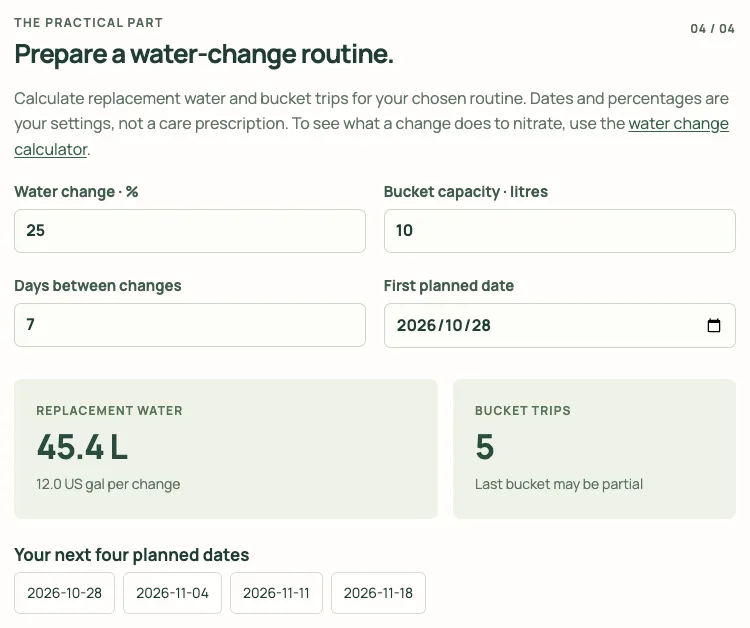
The percentage is of the water in the tank, not the label. A standard 55 gallon filled an inch below the rim over 2 inches of sand holds at most about 47.9 gallons (see how many gallons your tank really holds). A 25% change on that is 12.0 gallons, or 3 trips with a 5 gallon bucket. The planner's water-change step does this from your own net volume and lists the next four dates.
Changing water safely
- Treat tap water with a conditioner that handles chlorine and, if your supply uses it, chloramine.
- Match the new water's temperature to the tank.
- The figures here are arithmetic, not a care prescription. Use your own test results, and the needs of your fish, to choose the routine.
Sources and method
- Every figure on this page is arithmetic from the formulas shown, calculated with the same code as the water change calculator. The 10 mg/L weekly rise and the 10 mg/L tap level are examples, not typical values.
- The 55 gallon volume comes from the Aqueon catalog, p. 66 dimensions, read 28 October 2026.